Infographic text included for screen readers:
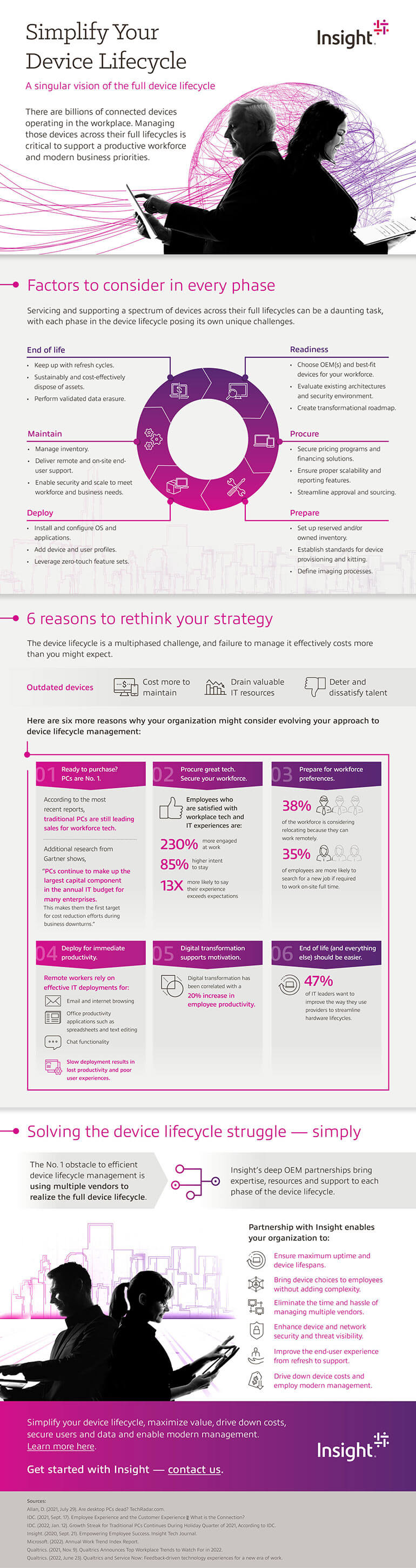
Simplify Your Device Lifecycle
A singular vision of the full device lifecycle. There are billions of connected devices operating in the workplace. Managing those devices across their full lifecycles is critical to support a productive workforce and modern business priorities.
Factors to consider in every phase
Servicing and supporting a spectrum of devices across their full lifecycles can be a daunting task, with each phase in the device lifecycle posing its own unique challenges.
End of life
- Keep up with refresh cycles.
- Sustainably and cost-effectively dispose of assets.
- Perform validated data erasure.
Maintain
- Manage inventory.
- Deliver remote and on-site enduser support.
- Enable security and scale to meet workforce and business needs.
Deploy
- Install and configure OS and applications.
- Add device and user profiles.
- Leverage zero-touch feature sets.
Readiness
- Choose OEM(s) and best-fit devices for your workforce.
- Evaluate existing architectures and security environment.
- Create transformational roadmap
Procure
- Secure pricing programs and financing solutions.
- Ensure proper scalability and reporting features.
- Streamline approval and sourcing.
6 reasons to rethink your strategy
The device lifecycle is a multiphased challenge, and failure to manage it effectively costs more than you might expect.
Outdated devices
- Cost more to maintain
- Drain valuable IT resources
- Deter and dissatisfy talent
Ready to purchase? PCs are No. 1.
According to the most recent reports, Ready to purchase? PCs are No. 1. Procure great tech. Secure your workforce. Prepare for workforce preferences. Deploy for immediate productivity. Digital transformation supports motivation. 01 02 03 End of life (and everything else) should be easier. traditional PCs are still leading sales for workforce tech. Additional research from Gartner shows, “PCs continue to make up the largest capital component in the annual IT budget for many enterprises. This makes them the first target for cost reduction efforts during business downturns.”
Procure great tech. Secure your workforce. Employees who are satisfied with workplace tech and IT experiences are:
- 230% more engaged at work
- 85% higher intent to stay
- 13% more likely to say their experience exceeds expectations
Prepare for workforce preferences.
- 38% of the workforce is considering relocating because they can work remotely.
- 35% of employees are more likely to search for a new job if required to work on-site full time.
Deploy for immediate productivity.
Remote workers rely on effective IT deployments for:
- Email and internet browsing
- Chat functionality
- Office productivity applications such as spreadsheets and text editing
- Slow deployment results in lost productivity and poor user experiences
Digital transformation supports motivation
Digital transformation has been correlated with a 20% increase in employee productivity.
End of life (and everything else) should be easier.
47% of IT leaders want to improve the way they use providers to streamline hardware lifecycles.
Solving the device lifecycle struggle — simply
The No. 1 obstacle to efficient device lifecycle management is using multiple vendors to realize the full device lifecycle. Insight’s deep OEM partnerships bring expertise, resources and support to each phase of the device lifecycle.
Partnership with Insight enables your organization to:
- Ensure maximum uptime and device lifespans.
- Bring device choices to employees without adding complexity.
- Eliminate the time and hassle of managing multiple vendors.
- Improve the end-user experience from refresh to support. Enhance device and network security and threat visibility.
- Drive down device costs and employ modern management