Blog Unpacking Gen AI: Demystifying the Current Artificial Intelligence Landscape
By Carmen Taglienti / 27 Sep 2023 / Topics: Artificial Intelligence (AI) , Generative AI , Analytics

With so many AI terms floating around, many leaders may be wondering what they should leverage for business value and why.
The state of AI
With 72% of professionals reporting they plan to adopt generative AI technologies to boost productivity across their organization,1 it’s clear there’s immense buzz around the emerging popularity and viability of generative AI. But for some, this new technology has created additional confusion: What are all these AI technologies, and what can you reasonably expect from them in a business context? AI has a variety of applications across industries and can be leveraged for benefits to productivity, operational efficiency, and improving employee or customer experiences. Let’s unpack all the types of AI and how your business can benefit.
Decoding key terms
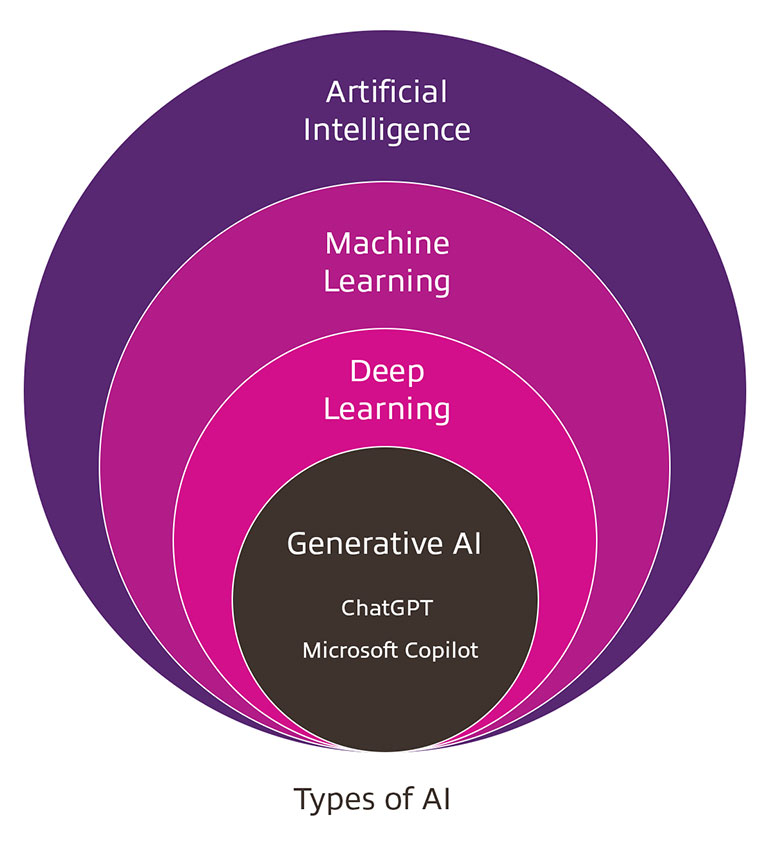
Artificial intelligence is part of a larger group of technologies that organizations can leverage for immense benefits. Here’s a breakdown:
- AI: This technology uses computation to do tasks that we typically expect humans would need to complete.
- Machine Learning (ML): This takes in data to learn and improve predictions over time.
- Deep learning: A subset of ML, this technology also learns from data but is able to make informed, intelligent decisions on its own.
- Generative AI: While this subcategory of AI also learns from data, it is able to create brand-new content in the form of text, images, etc.
Applications for types of AI
Machine learning
- Help diagnose and determine the estimated prognosis of diseases.
- Support organizations in detecting fraud and security risks.
- A popular model called computer vision can give insights for improving product placement.
Generative AI
- A marketing department could have social posts developed based on blog content they wrote.
- Support developers by writing sections of code to streamline programming.
- Personalize medical treatment plans for patients depending on existing conditions.
What are models?
Part of the AI conversation is the concept of models, which have different specializations to enable solutions like generative AI. Models are the algorithms that allow these solutions to learn and then predict, make decisions or generate content. ML technologies specifically are designed to learn from previous outputs/results and optimize over time. This is why generative AI in particular is revolutionary: It’s not only able to generate content, but theoretically, it will only get better at doing so with time. Here are some examples of models:
- Foundation models: These are large ML models that are trained on broad sets of data and can be fine-tuned for a wide range of uses. An example of a foundation model is BERT.
- Large Language Models (LLMs): Trained on vast amounts of data, these models interpret and generate humanlike text output, such as ChatGPT.
- Multimodal language models: These models work similarly to LLMs but are able to generate things other than text, such as images or videos.
- Dialogue LLM: These models are trained to engage in open-ended conversation with humans, which is typically leveraged for chatbots.
- QA LLM: These are trained to answer questions in a comprehensive and informative manner.
 Putting it all together</h2>\r\n<p>With so many ways to tap into AI solutions, there is a wide range of possible applications for every organization. Tapping into these technologies doesn’t just improve internal efficiency or customer experiences, it can also be critical to establishing differentiation from competitors. With solutions ranging from <a href=\"/content/insight-web/en_US/content-and-resources/2022/unlocking-the-power-of-data-and-ai.html\">machine learning</a> to generative AI, organizations can choose more mature technologies and/or branch out as early adopters for even higher potential ROI.</p>\r\n"}}" id="text-fb1f18f2fc" class="cmp-text global-base">
Putting it all together
With so many ways to tap into AI solutions, there is a wide range of possible applications for every organization. Tapping into these technologies doesn’t just improve internal efficiency or customer experiences, it can also be critical to establishing differentiation from competitors. With solutions ranging from machine learning to generative AI, organizations can choose more mature technologies and/or branch out as early adopters for even higher potential ROI.

Carm Taglienti
Chief Technology Officer, Insight Public Sector
Carmen has more than 25 years of experience as a cloud computing, data science, data analytics and data management expert. As a Chief Technology Officer for Insight Public Sector, he focuses on cloud-based business solutions across multiple industries and technical domains. He also serves as an adjunct professor at Northeastern University Khoury College of Computer Sciences and the College of Professional Studies teaching graduate courses in data science, cloud computing and analytics. Carmen is a published author and speaks at industry and technology events.
 Monthly perspectives from global tech leaders.