Blog What’s the difference between AI and ML?
By Simon Margolis / 4 Oct 2023 / Topics: Artificial Intelligence (AI) , Generative AI , Analytics , IT modernization

Key takeaways
- Artificial Intelligence is a broad field, and Machine Learning is a subset that enables systems to learn from data.
- AI is the goal of creating intelligent systems, while ML is the method used to achieve that goal through data-driven learning.
- Machine Learning makes AI systems more adaptive by continuously analyzing data and improving performance over time.
Artificial intelligence (AI) and machine learning (ML) represent a quantum leap in the evolution of technology. They are already being used to transform businesses and industries across the globe, and their potential impact is only going to grow in the years to come. But what’s the difference between AI and ML? Are the terms interchangeable? And how can they be used to solve real-world problems?
Let’s explore the spectrum of AI and ML, ranging from purpose-built services such as Contact Center AI (“CCAI”) to the “raw materials” that machine learning engineers use to build bespoke models and services.
I’ll also discuss how Insight helps our customers dial in the right artificial intelligence or machine learning solution for their specific use cases with the goal of using “Google magic” services and investing effort and time only into areas where an out-of-the-box solution is too general.
Artificial intelligence (AI) and machine learning (ML): Are they the same thing?
AI: machines designed to emulate the human mind
AI is a broad term that refers to the ability of machines to emulate human intelligence. This includes tasks such as learning, problem-solving, and pattern recognition. We typically consider AI solutions to be products or services that are built to accomplish tasks at various levels of specificity.
AI tools can often be used by people who do not have extensive backgrounds in data science, machine learning engineering, or other technical disciplines.
The most common types of AI
There are many different types of AI, but some of the most common include:
- Natural language processing (NLP): Natural language processing refers to the ability of machines to understand and process human language
- Computer vision: Computer vision refers to the ability of machines to see and interpret images
- Machine learning: Machine learning refers to the ability of machines to learn from data and improve their performance over time
These examples demonstrate AI solutions that serve a purpose either alone or as part of a system that leverages AI and other technologies.
Machine learning: a subset of AI
ML is a subset of AI that deals with the development of algorithms that can learn from data. ML algorithms are used to train machines to perform tasks such as image recognition, natural language processing, and fraud detection. ML tools and techniques are often used to create AI solutions that can be used by a significantly wider audience.
The most common types of machine learning
There are many different types of machine learning algorithms, but some of the most common include:
- Supervised learning: The algorithm is trained on a set of labeled data. The algorithm then learns to map the input data to the output labels.
- Unsupervised learning: The algorithm is trained on a set of unlabeled data. The algorithm then learns to find patterns in the data.
- Reinforcement learning: The algorithm is trained by trial and error. The algorithm learns to take actions in an environment in order to maximize a reward.
AI and ML exist on a spectrum
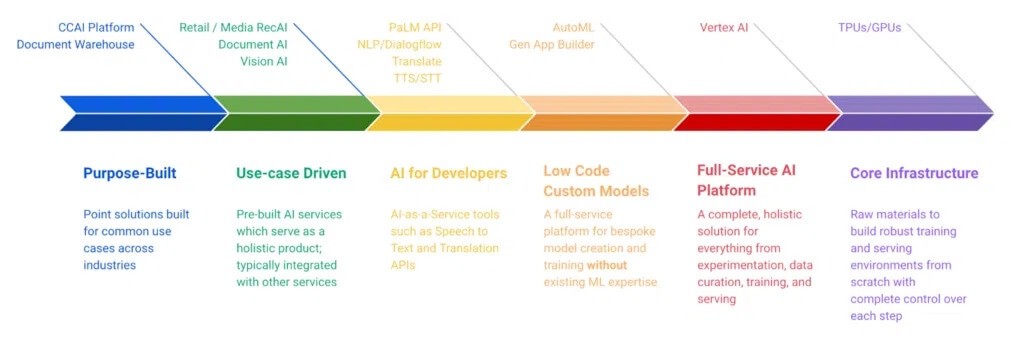
The image above illustrates that in practice, AI and ML exist on a spectrum with varying degrees of complexity between the extremes. On the one side, we see tools built to solve hyper-specific problems. Products like Google’s CCAI are an example of an AI platform that is built to specifically address the needs of call center operators. While ML technologies and approaches were used to build the underlying models, it is the customization of those models and orchestration between them that creates the solution that can be used to benefit agents, and ultimately customers.
On the other end of the spectrum, we have the “building blocks” used by machine learning engineers to do their work, eventually leading to built AI solutions. This includes frameworks such as TensorFlow and PyTorch as well as the physical hardware needed for the heavy computational workloads, such as TPUs, GPUs, and data platforms.
How can AI and ML be used to solve real-world problems?
AI and ML are already being used to solve real-world problems in a variety of industries.
We see the majority of our customers leveraging AI and ML solutions that end up somewhere in the middle of the extremes previously mentioned. In fact, the most valuable implementations of these technologies involve stringing together multiple, purpose-built solutions and only moving to the right in the diagram above when customization is required.
An example of this is an application built to assess documents for images with sensitive content. Instead of building a model from scratch to identify images in a document, pre-built AI services such as Google’s Document AI or Vision AI could be used to identify where images are in documents and to extract them. When the definition of “sensitive” is extremely specific to the given use case, the out-of-the-box Vision AI safety features may prove too broad, necessitating a step to the right and invoking some ML techniques to build a domain-specific image sensitivity model.
How AI and ML are being used across verticals
We see even more examples across many verticals, such as:
- Healthcare: AI used to develop new drugs, diagnose diseases, and provide personalized care.
- Finance: AI used to detect fraud, manage risk, and make investment decisions.
- Retail: AI used to recommend products, personalize shopping experiences, and optimize supply chains.
- Manufacturing: AI used to improve quality control, automate tasks, and optimize production.
How does Insight help customers dial in the right AI and ML solution for their use case?
Insight is a Google Cloud Premier Partner that helps businesses of all sizes adopt and use Google Cloud technologies. We have a team of experts who can help you assess your needs, identify the right AI and ML solutions for your business, and implement and manage those solutions.
We pride ourselves in helping our customers dial in the right solution for their needs. This means ensuring that we don’t needlessly recreate the wheel when a pre-built artificial intelligence or machine learning solution may serve the need.
We also ensure that customers use the right tool for the right job, such as using Google’s text-bison model to generate product descriptions and Google’s code-bison model to create a JSON from that AI-generated description.
We offer a variety of services to help you get the most out of your artificial intelligence and machine learning investments, including:
- Training: custom courses and workshops on AI and ML
- Consulting: services to help you develop and implement AI and ML solutions, ranging from advisory to hands-on solution development
- Support: 24/7 support for your AI and ML solutions
We’d love to hear more about your use cases and where you hope to leverage AI and ML in your business. To learn more about how AI and ML can help you achieve your most ambitious business outcomes, contact us today, or schedule a workshop to discuss how your organization can develop a generative AI strategy, with Duet AI, Vertex, and other innovations native to Google Cloud.
 Monthly perspectives from global tech leaders.