Article 4 Technology Trends Impacting Federal Cloud Computing
Many federal agency IT teams are stretched thin by the accelerating pace and complexity of emerging technology trends: A growing list of government IT-related mandates, an increased focus on cybersecurity, and the need to deliver a modernized set of tools and infrastructure — while still devoting the majority of the IT resources to maintaining rapidly aging legacy systems.
By Amanda Best / 24 Aug 2016 / Topics: Data center , Cloud , Cybersecurity , Intelligent edge

Partnering with an independent third party for federal IT consulting is one solution to overcoming these challenges.
One solution provider, Deltek, advises four growth areas for federal IT service providers through 2021:
1. Federal government cloud computing comes into its own.
In February 2011, the U.S. Chief Information Officer (CIO) released the Federal Cloud Computing Strategy, charting a “cloud-first approach” for an estimated $20 billion of the federal government’s $80 billion in annual IT spending at the time.
Several federal agency IT leaders convened in spring 2016 to discuss their cloud migration struggles as part of a panel discussion hosted by Federal News Radio. The top four government cloud computing obstacles to success they identified included:
- The cost of migration
- The immobility of some legacy systems
- Re-architecting systems to be truly “cloud native” rather than just “lifting and shifting”
- A relentless focus on security
- As the Food and Drug Administration’s CIO Todd Simpson wryly observed during the discussion, "Security is probably the one thing that could get me fired.”
2. Federal government information security gets focused.
Simpson’s comment may have been a nod to the February 2016 resignation of the Office of Personnel Management’s CIO. The exit took place in the wake of that department’s massive breach the previous year, which exposed 21.5 million federal employee and contractor records.
As federal agencies race to safeguard their systems and data, many are focusing their limited resources on five key areas:
- Threat identification
- Data protection
- Detection security
- Response security
- Disaster recovery
3. Big data volume quadruples.
Many of the recent cybersecurity challenges are driven not just by the increasing sophistication of the attackers themselves, but also by the vulnerability created by massively expanding datasets that must be carefully monitored and protected.
By 2020, Federal Communications Commission CIO David Bray expects the current volume of data to grow 20 times larger in the next five years.
Few if any agencies are prepared to:
- Handle data volumes that are projected to grow 400% annually due to the proliferation of Internet of Things devices like body cameras on law enforcement and military personnel
- Gain actionable insights by implementing data analytics infrastructure and building the right team of subject matter experts and data scientists who will ask the right questions and get the right answers
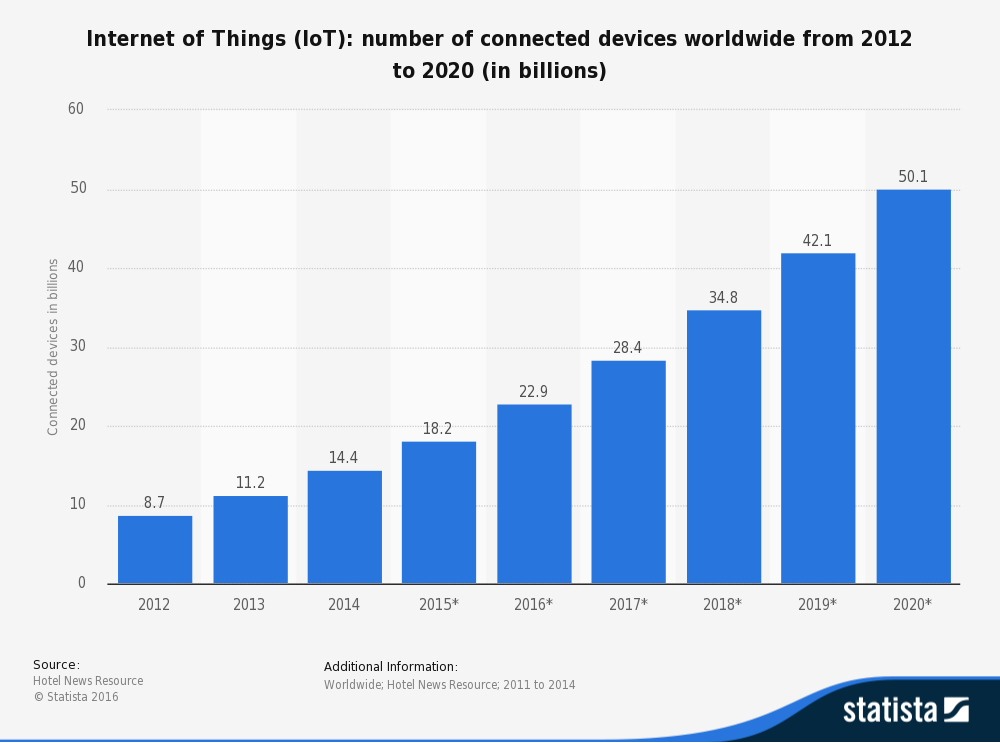
Figure 1 charts the rapid growth in the number of internet-connected devices, worldwide, between 2012, at 8.7 million devices, through an estimated 50.1 million devices in 2020.
4. Government data centers require refresh in the face of roadblocks to federal data center consolidation initiatives.
The federal push toward the cloud, increased focus on security and the exponential growth of data have exposed how ineffective today’s siloed legacy data architectures are when it comes to meeting the rapidly changing needs of federal agencies and their constituents.
As eager as federal IT teams may be to streamline their data centers and drive greater efficiency and effectiveness, there are still a number of significant challenges those teams are facing as part of their migration efforts, including:
- Version-locked IT systems, including Windows XP and Windows 2003
- The adoption of new “bi-modal IT” architectures that favor speed and agility, while continuing to deliver the uptime and scale the agency depends on each day
- Resource constraints; next generation data center architectures offer a proven way to do more with less, but migrating to a next-gen architecture requires time and money agencies simply don’t have
Tech partners are invaluable.
In an era of increasing internal and external demands and flat budgets, partnering with a federal IT consulting provider can relieve some of the pressure your team is feeling, allowing you to deliver on the growing list of initiatives on your project roadmaps. Some of the benefits of partnering with a third party include:
- Increased scale — When projects and roadmaps expand, service partners can rapidly deliver the increased manpower needed to get timelines back on track.
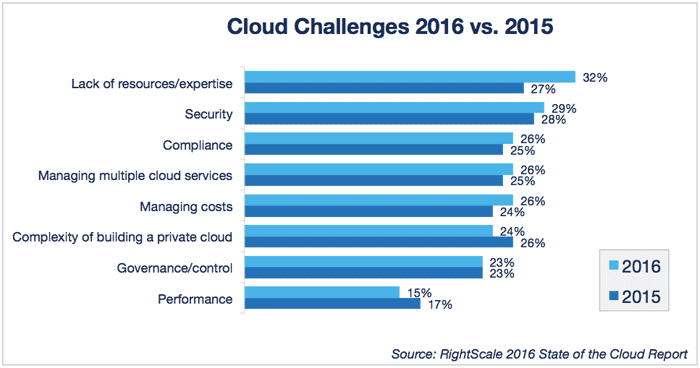
- Need-specific expertise — Overcoming many of the challenges listed above require highly specific proficiency in the latest technologies and trends, often in many different areas within one initiative. According to a January 2016 survey conducted by RightScale, 32% of respondents indicated that a lack of resources or expertise for cloud computing was a risk of cloud adoption for their enterprise, as shown in Figure 2 below.
- On-demand availability — Service partners can bring resources to bear much more quickly than the time needed to search for and onboard new hires. Just as importantly, they can disengage as soon as projects are completed and the need dissipates.
- Improved focus — Your team gets pulled in many different directions on a daily basis. Service providers offer the benefit of operating only on the project(s) at hand, dedicating their efforts exclusively in the areas you choose.
Insight is proud of its role as a solutions aggregator for the public and private sectors. During a recent engagement, our subject-matter experts created a secure infrastructure for a federal agency with 350,000 employees across the U.S., including one million mailboxes, and consolidated everything into four data centers. We offer a number of advantages that you should consider when it comes to selecting a federal IT service partner:
- Objective and vendor-agnostic approach — Insight is a value-added reseller for a deep line card of leading technology providers, including the top names in security solutions. You can be confident that Insight will look at your needs first, recommending the best solutions available from our more than 3,600 technology provider partners. When it comes time to deploy those solutions, we rely on the manufacturers' best practices and standards.
- Solutions aggregator — Our process and subject-matter experts go beyond the traditional value-added reseller capabilities, augmenting and collaborating with your existing IT team, adding scale and expertise where needed to ensure your implementation will be as seamless and successful as possible.
- Reduced solution procurement — Due to Insight’s technology relationships, sourcing power and fixed contracts, we can lock in pricing.
- A focused agency IT team — We leverage scope, scale and federal government-specific resources.
Above all, partnering with Insight means tapping into our significant experience in managing technology and serving as a trusted advisor for the government sector.