Infographic text included for screen readers:
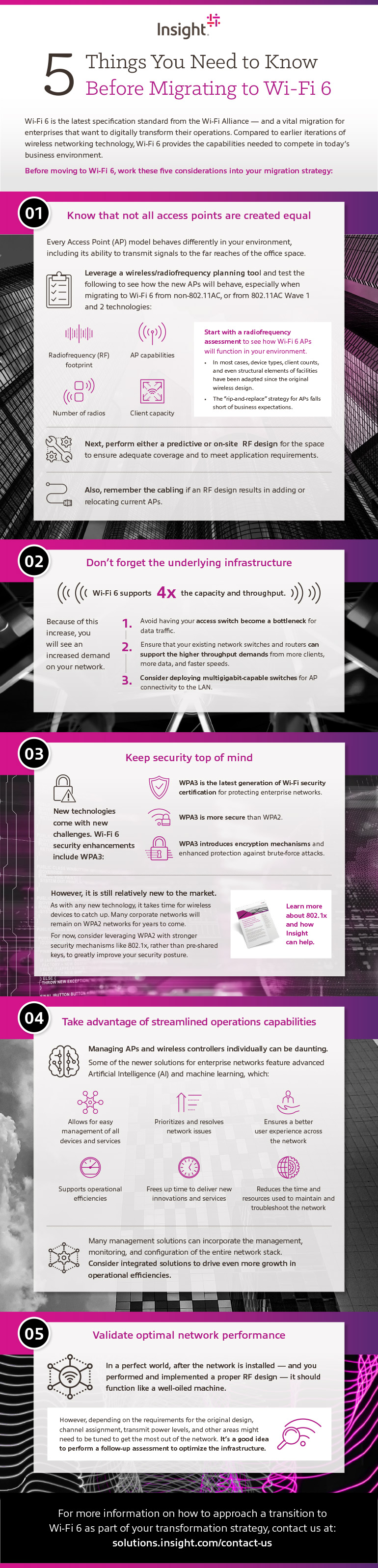
Wi-Fi 6 is the latest specification standard from the Wi-Fi Alliance — and a vital migration for enterprises that want to digitally transform their operations. Compared to earlier iterations of wireless networking technology, Wi-Fi 6 provides the capabilities needed to compete in today’s business environment. Before moving to Wi-Fi 6, work these five considerations into your migration strategy:
1. Know that not all access points are created equal
Every Access Point (AP) model behaves differently in your environment, including its ability to transmit signals to the far reaches of the office space.
Leverage a wireless/radiofrequency planning tool and test the following to see how the new APs will behave, especially when migrating to Wi-Fi 6 from non-802.11AC, or from 802.11AC Wave 1 and 2 technologies:
- Radiofrequency (RF) footprint
- AP capabilities
- Number of radios
- Client capacity
Start with a radiofrequency assessment to see how Wi-Fi 6 APs will function in your environment.
- In most cases, device types, client counts, and even structural elements of facilities have been adapted since the original wireless design.
- The “rip-and-replace” strategy for APs falls short of business expectations.
Next, perform either a predictive or on-site RF design for the space to ensure adequate coverage and to meet application requirements.
Also, remember the cabling if an RF design results in adding or relocating current APs.
2. Don’t forget the underlying infrastructure
Wi-Fi 6 supports 4x the capacity and throughput.
Because of this increase, you will see an increased demand on your network.
- Avoid having your access switch become a bottleneck for data traffic.
- Ensure that your existing network switches and routers can support the higher throughput demands from more clients, more data, and faster speeds.
- Consider deploying multigigabit-capable switches for AP connectivity to the LAN.
3. Keep security top of mind
New technologies come with new challenges. Wi-Fi 6 security enhancements include WPA3:
- WPA3 is the latest generation of Wi-Fi security certification for protecting enterprise networks.
- WPA3 is more secure than WPA2.
- WPA3 introduces encryption mechanisms and enhanced protection against brute-force attacks.
However, it is still relatively new to the market. As with any new technology, it takes time for wireless devices to catch up. Many corporate networks will remain on WPA2 networks for years to come. For now, consider leveraging WPA2 with stronger security mechanisms like 802.1x, rather than pre-shared keys, to greatly improve your security posture.
4. Take advantage of streamlined operations capabilities
Managing APs and wireless controllers individually can be daunting. Some of the newer solutions for enterprise networks feature advanced Artificial Intelligence (AI) and machine learning, which:
- Allows for easy management of all devices and services
- Prioritizes and resolves network issues
- Ensures a better user experience across the network
- Supports operational efficiencies
- Frees up time to deliver new innovations and services
- Reduces the time and resources used to maintain and troubleshoot the network
Many management solutions can incorporate the management, monitoring, and configuration of the entire network stack. Consider integrated solutions to drive even more growth in operational efficiencies.
5. Validate optimal network performance
In a perfect world, after the network is installed — and you performed and implemented a proper RF design — it should function like a well-oiled machine.
However, depending on the requirements for the original design, channel assignment, transmit power levels, and other areas might need to be tuned to get the most out of the network. It’s a good idea to perform a follow-up assessment to optimize the infrastructure.