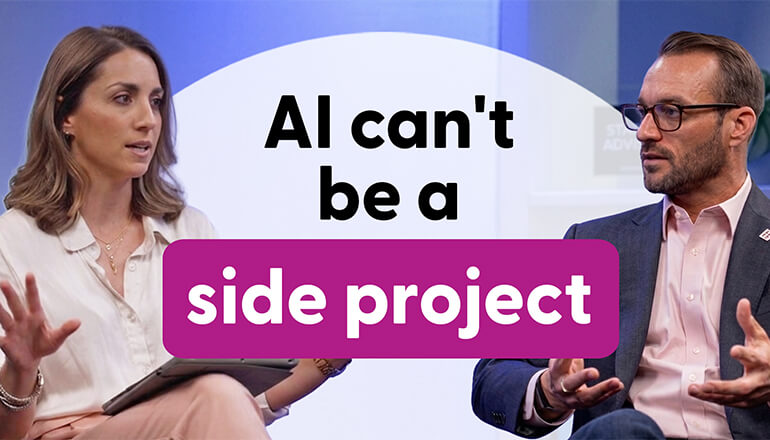
Article AI’s Next Decade: From Pilots to Platforms
By Parker Johnston / 9 Jul 2026 / Topics: Artificial Intelligence (AI) , Solutions Integrator , Generative AI , Cloud

Part 1: 2026 is the pivot year.
In 2026, most organizations are operationalizing AI. The tools are in place. The question is how they’re being used, and if they’re actually improving work.
According to a study from MIT, more than 80% of companies have piloted generative AI, yet fewer than 5% have moved initiatives into production at scale.1
At the same time, 85% of organizations increased AI investment last year — and 91% plan to continue increasing it, even as reported ROI falls short of the typical cost of capital.2 On the surface, the signal is contradictory: rising investment, limited adoption of production, and returns that don’t meet expectations.
It’s easy to read that as failure. It isn’t?
Across enterprises, AI isn’t stalling — it’s diffusing.
Not as large, visible programs, but incrementally inside day-to-day work. Teams are using copilots, assistants, and models to complete tasks faster, improve output, and reduce manual effort. That progress rarely shows up as a single, reportable win, but it compounds across workflows.
The disconnect comes from how these efforts are structured and measured.
Most AI initiatives are still treated like standalone projects, funded as large, end-state bets and evaluated all at once. When they don’t deliver immediate, visible returns, they’re labeled as failures and often shelved. But most projects fail, not just AI ones. What’s different here is the expectation that value should arrive fully formed, rather than being built incrementally.
Organizations making progress are taking a different approach. They’re not trying to prove AI in isolation. They’re integrating it into workflows and measuring value where the work happens: time saved, output quality, and how consistently teams use the tools available to them.
That shift is subtle, but it changes everything.
Because while the data suggests hesitation, what’s happening on the ground is momentum.

The barrier is no longer access — it’s integration.
In many cases, this lag isn’t cultural or technical; it’s structural. Organizations that missed early AI investments are only now entering a budget cycle where funding and commitment can catch up.
This is why 2026 marks a real pivot. Organizations are moving past the question of whether AI works and into the harder problem of making it usable, repeatable, and accountable inside the business.
That shift is also changing how leaders think about value. A $20-per-user assistant doesn’t behave like a capital investment; it behaves like a productivity layer. Organizations that see results measure impact within the workflow, not in isolated ROI calculations.
It’s also changing how organizations build. The barrier to creating useful applications has dropped significantly. Teams can now spin up lightweight, as-needed solutions using the tools they already have, instead of relying on long development cycles or external vendors. Instead of sourcing capability, they can assemble it directly inside their workflows.
Consolidation follows that behavior. As platforms bundle more capabilities and teams gravitate toward tools that fit naturally into their work, redundant solutions fall away. The decision is less about which model to use and more about which tools help teams do their jobs.
Insight is seeing this play out directly. The most effective approach has been to remove barriers to entry and encourage broad, hands-on use across tools and platforms. When teams are given space to experiment — securely and within guardrails — adoption follows quickly.
Use the tools, try things, build something.
The risk of adopting AI is lower than most teams assume, and the fastest way to understand value is to experience it in the flow of work. From there, it becomes easier to identify what’s worth scaling, what isn’t, and where governance is needed.
That matters because the next challenge is already emerging. As AI becomes embedded in workflows, organizations need to think more seriously about how agents access data, take action, and operate securely across systems.
The takeaway is this: Spend is rising, but patience is thinning — and organizations are under pressure to turn distributed, incremental gains into something repeatable and scalable.
That’s the shift from pilots to platforms.
A quick way to orient your organization
If success is measured by how many teams tried a tool, you’re still in pilot mode. If success is measured by what changed in the workflow — cycle time, rework, cost-to-serve, quality, and risk — you’re building an enterprise capability.
The 2026 pivot is about moving measurement, ownership, and standards into the center of how AI is used day to day.
Your pivot checklist for 2026
To maximize value this year and set up the rest of your decade for success, focus on the basics that make scaling possible. Organizations making this shift tend to converge on a similar set of practices:
- Most pilots don’t fail because the model doesn’t work — they fail in the gaps between systems, data, and teams, not in the demo.
- Trace the workflow from end to end and note where it breaks in the real world. Are there unclear handoffs, missing approvals, no trusted content path, or no way to measure whether the output helped?
- Choose 3–5 workflows to scale. Pick a small set of workflows that are frequent, measurable, and painful enough that improvement matters, but bounded enough to control risk.
- Use simple filters: business impact, implementation feasibility, and risk tier, then commit to scaling those incrementally before expanding the portfolio.
- Define what “production” means. “In production” shouldn’t mean “some teams used it.” It should mean consistent, repeated use tied to a defined outcome.
- Set an adoption threshold (who uses it and how often), success metrics (what improves), guardrails (what it can and can’t do), and a clear sign-off path so accountability is explicit. If you can’t describe how it’s monitored and who owns incidents, it’s not production.
- Consolidate where it reduces friction. Tool sprawl creates duplicated effort and inconsistent controls, especially when every team picks its own assistant, vector store, or evaluation method.
- Over time, teams will naturally converge on the tools that fit their workflows — standardize those paths so others can reuse them.
- Treat governance as a requirement. Governance should be part of the delivery pipeline, not a review that happens after something is already live.
- Build risk tiers, approval workflows, audit logs, and escalation rules into the release process so teams can move faster without accumulating hidden exposure.
- Measure value in the workflow, not in abstract “AI usage” or isolated ROI metrics. Track outcomes before and after deployment and keep tuning based on the workflow data. If the workflow didn’t improve, the AI didn’t matter.

How Insight helps
When you’re trying to escape pilot purgatory, the hardest part is seeing a path through the complexity. Insight Prism™ helps you break a crowded set of pilots into a clear, prioritized way forward.
Prism gives you an AI roadmap from the start, so you can focus on the workflows worth scaling, with ROI and risk considered upfront. It’s designed to turn AI planning into ongoing management, not a one-time report.
With Prism, Insight helps you execute a practical path to production with lightweight readiness criteria, governance gates that don’t stall delivery, and measurement tied to workflow results. On the execution side, we modernize the cloud and data foundations those use cases depend on — and put practical controls in place so scaling doesn’t create new security, compliance, or cost surprises.
Sources:
1. MIT NANDA. (July 2025). The GenAI Divide: State of AI in Business 2025.
2. Deloitte. (2025, Oct. 22). AI ROI: The paradox of rising investment and elusive returns.
About the Authors:

Parker Johnston
Agentic Field CTO, Insight
Parker is an agentic field CTO within Insight's Microsoft solutions business line and an AI strategist who helps organizations design, implement, and scale enterprise technology solutions. During his 15-year career, he has led initiatives focused on enterprise modernizations, cloud uplifts, AI-driven transformations, and reimagination of critical systems. In his current role, Parker drives go-to-market strategies for technology solutions with an emphasis on AI, helping clients modernize legacy systems, automate software delivery, and realize measurable value. He works to ensure organizations are empowered to pursue transformation and growth without being limited by technology, providing a solid plan, trusted guidance, and an evolving roadmap that balances business priorities with technological advances.
 Monthly perspectives from global tech leaders.