Article Five Ways Apple Devices Help You Reduce Total Cost of Ownership (TCO) Across Your Healthcare IT Fleet
By Insight Editor / 21 May 2026 / Topics: Devices , Device lifecycle , Employee experience , Digital transformation

How to reduce operational strain and improve efficiency across the care environment.
Most healthcare IT leaders already recognize the value of Apple devices for care delivery.
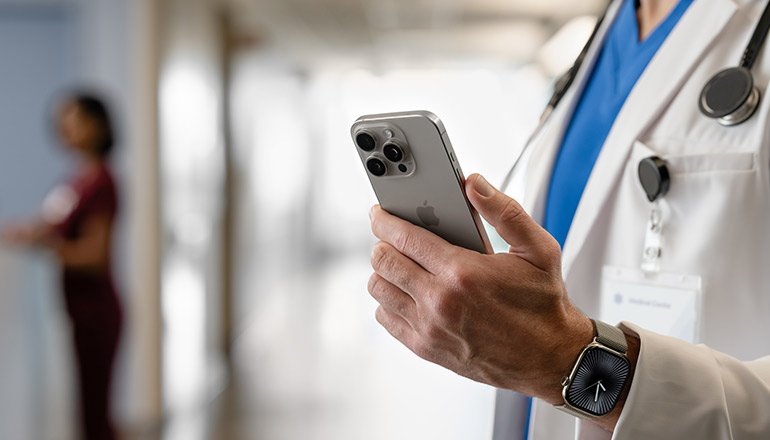
With powerful Apple silicon and on-device AI, Apple devices and apps simplify clinical workflows and support better care outcomes. They’re intuitive to use, simple for IT to manage, and enable faster, more secure access to the electronic health record (EHR) systems clinicians rely on daily.
What many organizations don’t realize is that Apple devices can also help healthcare organizations reduce TCO — delivering greater efficiency over time, especially when supported by a healthcare IT partner with deep experience navigating tight budgets.
As an Apple Premium Business Partner, Insight often works with healthcare organizations that have selected Apple devices to reduce TCO. In this article, we’ll explain why Apple devices are the right choice not only for care, but also for your IT budget.

A smarter way to reduce TCO
From longer-lasting devices to zero-touch deployment, here are five ways Apple and Insight help you save.
1. Save on onboarding costs with intuitive devices
Apple devices are intuitive to use, which lessens friction and tech fatigue across care teams. That ease of use often translates into meaningful cost savings by reducing training and adoption time. Stanford Medicine Children’s Health, for example, saved $1.3 million over 18 months on onboarding costs by introducing Apple devices into its training workflows. And when it’s time to equip new hires, zero-touch deployment and remote configuration from Insight make it easy to roll out devices with minimal hands-on setup, further lowering the internal resourcing required to get clinicians up and running.
2. Reduce charting burden with AI-powered workflows
With iPhone and iPad, ambient documentation becomes part of the care experience — not a separate task afterward. At the bedside or on the move, clinicians can securely capture notes, access patient information, and document care all on one device. Paired with the right AI-powered ambient tools, Apple devices help cut charting time dramatically, reduce after-hours work, and lower the operational costs tied to manual, repetitive documentation — all while delivering a familiar, intuitive experience clinicians actually want to use.
The challenge for most health systems isn’t imagining where AI could help — it’s knowing where to focus first and how to expand success without introducing compliance risk. That’s where Insight’s Radius™ AI comes in. Our architect-led workshops start with the high-value use cases clinicians are already running on iPhone and iPad — such as bedside charting, progress notes, and discharge documentation — and then identify adjacent opportunities where HIPAA-compliant AI on Apple devices can remove even more administrative burden.
From there, Radius™ AI moves quickly into rapid prototyping and proof-of-concept development through Insight’s Prism™ platform, so your clinical and IT teams can see and validate new Apple-based AI workflows before heavy engineering begins. The result is a practical, governed roadmap for scaling AI across your Apple fleet — extending the impact from reduced charting burden to broader gains like faster discharge throughput, more efficient prior authorizations, and better care coordination, all contributing to a lower total cost of ownership.
3. Maximize the value of the device lifecycle
Apple devices are built for long lifecycles and have high residual value, maintaining 30% of their value over 4 years compared to 15% for typical enterprise PCs. When it’s time to upgrade, the Apple Business Trade In program offers a simple process for eligible device trade-in that helps you offset the costs of newer hardware.
Insight’s Flex for Devices program — powered by Advanced Asset Management for real-time fleet visibility — helps healthcare IT teams refresh Apple devices based on performance data instead of rigid timelines. By identifying which devices can safely stay in service and which should be refreshed, you can avoid unnecessary replacements, capture more residual value, and significantly reduce total cost of ownership across your Apple fleet.
4. Lower IT burden by simplifying EHR access
Access challenges surrounding EHR systems — like password resets and authentication issues — are extremely frustrating for care teams. They also drive a high volume of IT support tickets, increasing IT burden and cost. With Face ID and Touch ID on Apple devices, clinicians get fast, secure access to the systems they rely on, reducing access-related ticket volume and helping teams move more efficiently throughout their shifts. Over time, fewer password and login issues translate into meaningful savings in help desk time and a better experience for care teams.
5. Use Apple’s secure ecosystem to reduce risk
Data breaches cost healthcare organizations an average of $7.42 million in 2025 — the highest of any industry. Apple’s tightly integrated hardware and software ecosystem helps reduce vulnerabilities that can emerge across fragmented care environments. Apple devices are designed with security built into every layer — from Apple silicon and Secure Enclave to biometric authentication, encryption, Secure Boot, and app protections — helping protect patient data and lower overall risk exposure.
Insight adds another layer of protection with managed security services that help healthcare organizations identify vulnerabilities and better secure their Apple environment. Together, Apple’s secure-by-design devices and Insight’s managed security capabilities help reduce the likelihood and impact of security incidents, protecting both patient trust and the bottom line.
Built for healthcare. Backed by Insight.
As a leading Apple healthcare technology partner, Insight helps healthcare organizations deploy, manage, and optimize Apple ecosystems built for modern care delivery. We work alongside IT teams to streamline workflows, strengthen security, improve fleet visibility, and reduce operational complexity across the device lifecycle.
Bespoke clinical software solutions
When clients come to us with clinical data challenges, we deliver.
From designing one of the world’s largest anonymized clinical trial data sharing platforms to building predictive treatment models for chronic conditions, we help turn health data into action.
 Monthly perspectives from global tech leaders.