Subscribe Stay Updated with Insight On
Subscribe to our podcast today to get automatic notifications for new episodes. You can find Insight On on Amazon Music, Apple Podcasts, Spotify and YouTube.
By Abhijeet Gulati / 5 Jun 2026 / Topics: Artificial Intelligence (AI) , Consulting services , Generative AI
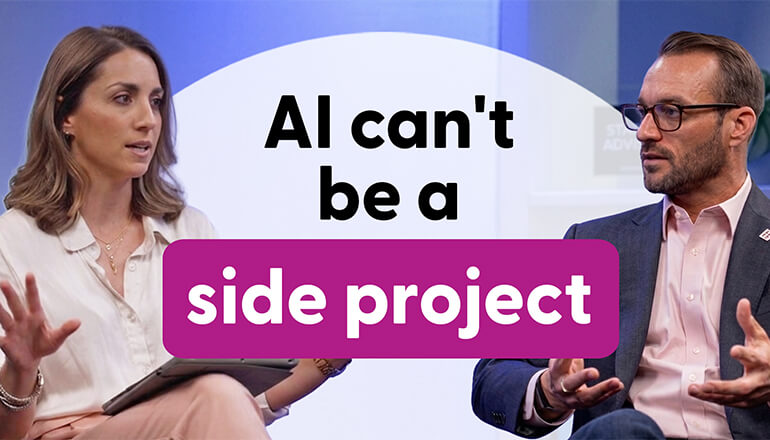
AI trust in regulated industries comes down to one paradox: You need speed to stay competitive, but a single inaccurate output can destroy the customer confidence you spent years building. The resolution is not choosing one over the other — it's building operational systems that make both possible simultaneously. The framework that works: Speed belongs in experimentation, but production-readiness is a separate judgment call governed by accuracy, accountability, and trust.
Abhijeet Gulati, head of AI and senior director of engineering at Mitchell (an Enlyte company), has spent nine years building AI into property and casualty insurance claims management — a domain where a wrong damage estimate has real financial consequences for real people. His team's approach centers on what he calls the velocity-veracity paradox: the tension between time to market and time to trust. Mitchell's resolution is a governed-first philosophy where experimentation moves fast, but the decision to ship into production requires a deliberate pause to assess whether the AI will enhance — not compromise — the system of record it's being embedded into.
Operationalizing AI bias is central to this approach. Bias is not a certification you check once — it's a routine that runs every iteration because all historical data contains bias, and AI trained on that data becomes a bias amplification engine without active normalization. Mitchell's team evolves their bias evaluation strategy continuously, adding new scenarios to their governance guardrails as they identify them. The test: If you don't trust your own AI, you can’t convince your customers to consume it.
Human-in-the-loop design is the other critical piece. AI should augment human judgment, not replace it — particularly at points of uncertainty. When the AI is confident a decision is correct, it proceeds. When there's a vector of uncertainty, the system reflects that and routes the decision to a skilled human. This symbiotic relationship between AI predictions and human judgment is what makes responsible AI deployment sustainable in regulated environments.
This is the final episode of a three-part series on AI as an operations force multiplier. Catch up on the full series: AI Didn't Replace These Workers — It Gave Them Their Mission Back and EP33.
If you liked this episode, share it with a colleague.
Have a topic you’d like us to discuss or question you want answered? Drop us a line at jillian.viner@insight.com

Abhijeet Gulati
Head of AI, Mitchell
Audio transcript:
We’re in the process of finalizing the transcript. Please check back soon for the completed version.

Marketing Manager, Insight
As marketing manager for the Insight brand campaign, Jillian is a versatile content creator and brand champion at her core. Developing both the strategy and the messaging, Jillian leans on 10 years of marketing experience to build brand awareness and affinity, and to position Insight as a true thought leader in the industry.
Head of AI, Mitchell
Subscribe to our podcast today to get automatic notifications for new episodes. You can find Insight On on Amazon Music, Apple Podcasts, Spotify and YouTube.